YARNSHAPE GUIDE
How to make crochet spheres, cones, and tubes
Three simple constructions cover a surprising range of objects. Their difference is the way the stitch count changes from one round to the next.
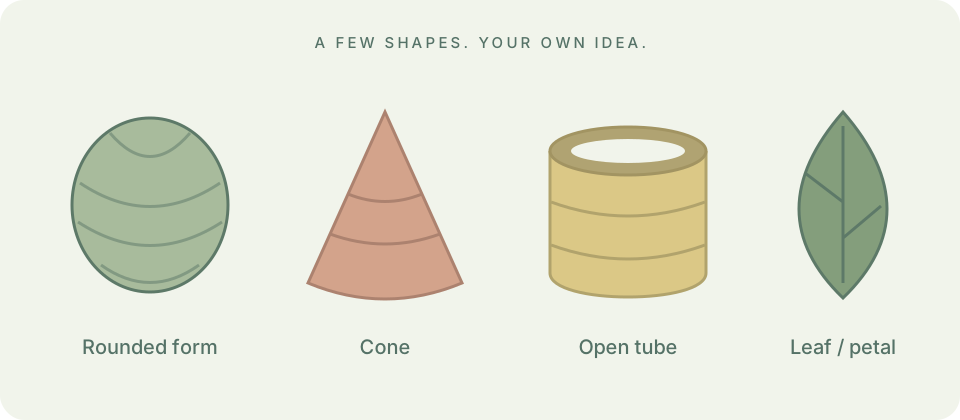
A rounded form grows, stays even, then closes
In Yarnshape, a basic rounded form begins with six single crochet stitches in a magic ring. Increase rounds add stitches to widen the piece, even rounds hold the stitch count steady, and decrease rounds narrow it toward the final opening. Leave space to stuff before the opening becomes too small.
The widest circumference is a stitch count around the piece, not its diameter. Extra straight rounds make it longer. Yarnshape’s “rounded form” is a draft shape rather than a guarantee of a mathematically perfect sphere. See the 18-stitch worked example for its actual rounds.
A cone widens toward an open base
A cone starts at the narrow end and grows through increases. Straight rounds between increases make the widening more gradual. In the studio, select Cone and try Slower widening. A carrot, a beak, and a pointed decoration can share this construction.
The broad end remains open in this construction. Record whether it should be lightly stuffed and sewn to another piece; a closed cone base needs a separate plan.
A tube starts with an opening
A tube begins with a chain joined into a ring, then rounds around that opening. Keep the count steady for straight walls or use the taper control to narrow the starting end. Both ends stay open and unstuffed in Yarnshape’s tube instructions.
A tube can suggest a stem, sleeve-like component, or band, but a wearable needs more than a cylindrical preview. Check actual circumference, ease, stretch, and seam placement. The studio does not generate complete graded garment patterns.
Choose a cup when you need a base
A cup grows from a closed circular base and then continues into walls with an open rim. It is a useful alternative for a small pretend container. A cup and a tube can look similar from the side while requiring different starts.
Check the next round against the previous one
An increase in these drafts works two single crochets into one stitch. A decrease works the next two stitches together. Count stitches at the end of each round and use a marker to identify the round’s beginning. Keep US and UK terminology consistent: the stitch called single crochet in US terms is double crochet in UK terms.
Use the studio’s Stitch help for terminology and the spacing helper. The stitch maps are schematic course layouts, not complete conventional charts for arbitrary stitch techniques.